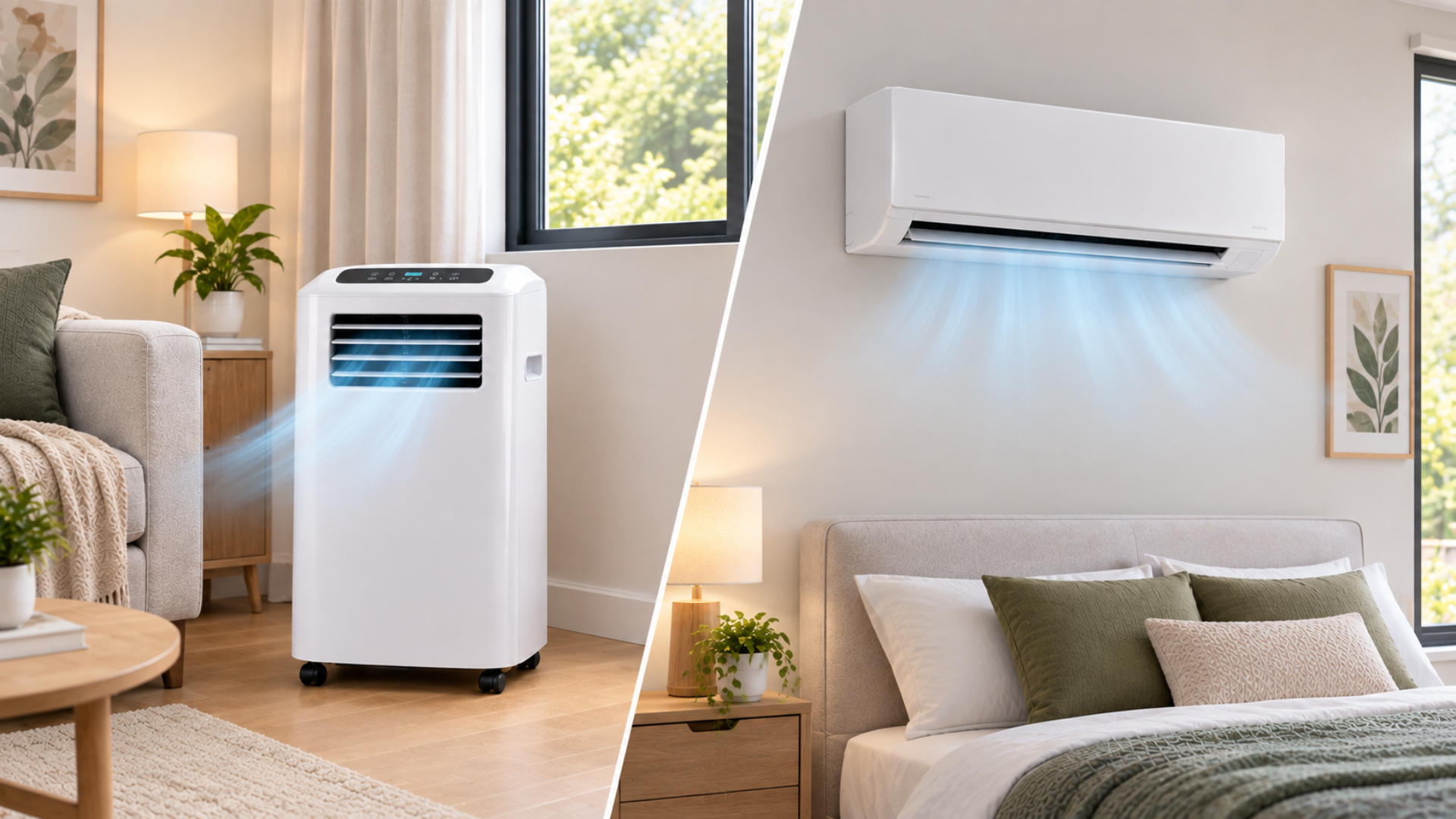
When a room becomes uncomfortable during a Western Australian summer, a portable air conditioner can look like an easy solution. It is relatively flexible, does not require the same permanent installation as a split system and may be useful for renters or households that need temporary cooling.
A split-system air conditioner, however, may be more suitable for a room that needs regular cooling over many summers.
The important question is not simply which unit costs less to buy. It is how well each option cools the space, how much electricity it consumes and what it costs to own and operate over time.
How the Two Air Conditioning Types Work
A portable air conditioner generally houses its main components in one unit. Many models use an exhaust hose to release warm air outside through a window or another suitable opening.
This arrangement makes the equipment movable, but the exhaust setup can affect cooling performance. If warm outdoor air enters the room to replace exhausted air, the unit may need to work harder to maintain the desired temperature.
A split-system air conditioner uses an indoor unit and an outdoor unit connected by refrigerant pipework. The system transfers heat from indoors to outdoors and is installed in a fixed location.
A well-selected split system can provide efficient cooling for a defined area, but performance still depends on the model, room conditions, installation quality and maintenance.
Which One Uses More Electricity?
There is no single answer that applies to every portable and split-system model.
Electricity use depends on several factors:
• The unit's electrical input power
• Its cooling capacity and efficiency
• The size and heat load of the room
• Outdoor temperature and direct sunlight
• The temperature setting
• How many hours the unit operates
• How effectively the cooled air stays inside the room
Some portable units may consume more electricity than an efficient split system providing comparable cooling. However, the result depends on the actual models and conditions being compared.
For a fair assessment, compare product specifications and energy-efficiency information, not just the purchase price or the number displayed on the packaging.
Calculate the Running Cost Before You Buy
You can estimate the energy cost using the unit's average electrical input.
Estimated cost = average power input (kW) × operating hours × electricity rate ($/kWh)
For example, suppose an air conditioner draws an average of 1.2 kW and runs for six hours. Using an illustrative electricity rate of $0.30 per kWh:
1.2 kW × 6 hours × $0.30 = $2.16
That represents the estimated cost for the example period, not a guaranteed price for any particular unit or WA electricity plan.
Actual consumption may vary. Inverter-driven air conditioners, for instance, can adjust their output rather than operating continuously at one fixed power level.
For a useful comparison, calculate the estimated cost of each unit using its relevant power consumption and expected operating hours.
Where Portable Air Conditioning Makes Sense
A portable unit may suit a household that needs occasional cooling in a room where permanent installation is impractical.
It may also be worth considering when flexibility is a priority, such as in a temporary living arrangement.
Before purchasing one, check the required exhaust arrangement, noise levels, drainage requirements and the manufacturer's recommended room conditions.
A unit that is easy to move is not necessarily the most effective option for a large room or an area exposed to strong afternoon sunlight.
When a Split System May Be the Better Option
For a room that requires regular cooling, a correctly sized split system may offer a more practical long-term solution.
The indoor unit's location, outdoor unit placement, refrigerant pipe route and electrical supply all need to be considered during installation.
Although the initial cost may be higher, it is worth comparing that cost with the expected running costs over several years.
The right choice depends on how often the room needs cooling, whether permanent installation is possible and how much you value flexibility.
The Room Matters as Much as the Unit
A room that receives direct western sunlight can have a much higher cooling demand during the afternoon than a shaded room of similar size.
Insulation, ceiling height, window area, air leakage and the number of occupants can all influence the heat load.
If the air conditioner is too small for the space, it may struggle to maintain comfort. A poorly selected or installed system may also deliver disappointing performance even if its advertised capacity appears adequate.
For this reason, choose cooling equipment based on the actual space and conditions rather than floor area alone.
Practical Ways to Reduce Air Conditioning Costs
Whichever system you choose, several habits can help reduce unnecessary electricity use.
Keep filters clean according to the manufacturer's instructions, limit direct sunlight with appropriate shading and close doors to areas that do not need cooling.
Set a practical temperature rather than demanding excessive cooling, and investigate rooms that remain warm despite long operating hours.
If you have rooftop solar, consider whether daytime cooling can align with periods of solar generation. The financial benefit depends on your solar output, household demand and electricity tariff.
Compare the Full Cost of Ownership
The lowest upfront price does not necessarily provide the best long-term value.
Compare purchase and installation costs, estimated electricity consumption, maintenance needs, expected use and the cooling performance required for your room.
Renostain can help you explore air conditioning and broader energy-efficiency options suited to your property.
Considering an air conditioning upgrade? Contact Renostain to discuss cooling solutions and energy use in your home.