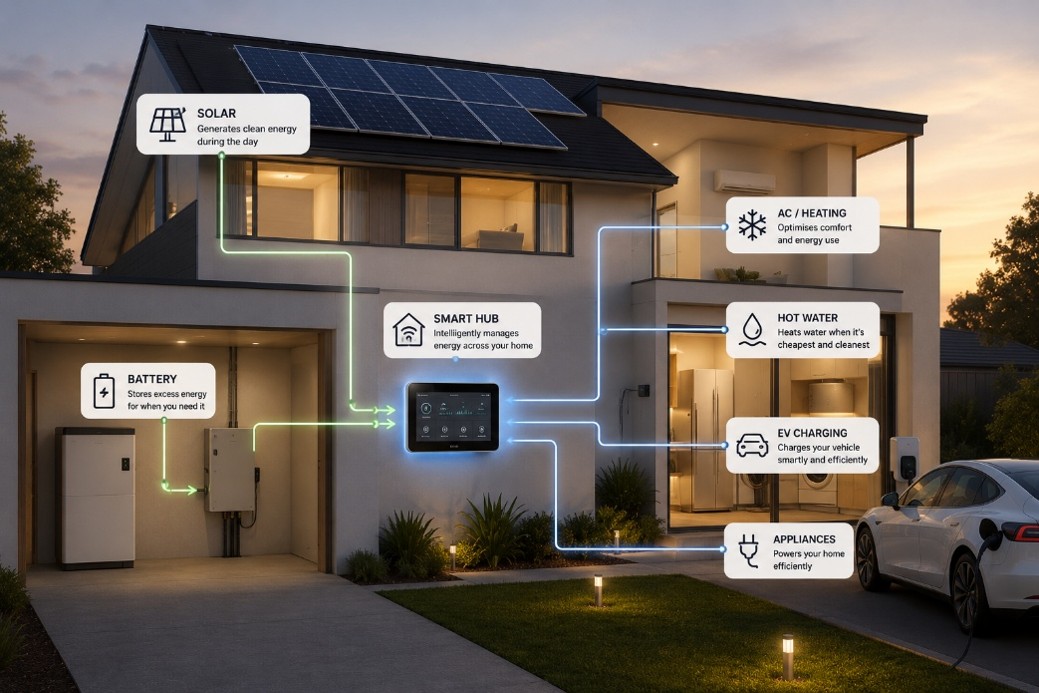
“Smart home” often means voice-controlled lights, automated blinds or an app that lets you turn the air conditioner on before arriving home.
But automation can go further.
For households with increasing electricity demand, smart technology can become part of an energy management strategy.
Think About What Uses the Most Energy
A home may have several significant electrical loads:
• Air conditioning
• Hot water
• Pool equipment
• EV charging
• Cooking
• Laundry
• Appliances
The goal isn't necessarily to turn everything off.
It is to understand when equipment operates and how it fits into the home's overall energy use.
Solar Changes the Conversation
If the property has solar, the timing of electricity use becomes more interesting.
Instead of simply generating electricity, the household can consider how available solar energy is used.
Australian government guidance recognises connected appliances, air conditioners and water heaters as examples of equipment that can form part of smart-home energy management.
The Future Is More Connected
Australia's consumer energy landscape increasingly combines:
Solar + Batteries + EVs + Smart Appliances + Energy Management
The Australian Government's Consumer Energy Resources Roadmap specifically identifies rooftop solar, home batteries, EV chargers and controllable appliances as connected consumer energy resources.
Renostain
Renostain's Home Automation and Energy Management capabilities can be considered alongside its solar and battery solutions where an integrated approach is appropriate.
But automation can go further.
For households with increasing electricity demand, smart technology can become part of an energy management strategy.
Think About What Uses the Most Energy
A home may have several significant electrical loads:
• Air conditioning
• Hot water
• Pool equipment
• EV charging
• Cooking
• Laundry
• Appliances
The goal isn't necessarily to turn everything off.
It is to understand when equipment operates and how it fits into the home's overall energy use.
Solar Changes the Conversation
If the property has solar, the timing of electricity use becomes more interesting.
Instead of simply generating electricity, the household can consider how available solar energy is used.
Australian government guidance recognises connected appliances, air conditioners and water heaters as examples of equipment that can form part of smart-home energy management.
The Future Is More Connected
Australia's consumer energy landscape increasingly combines:
Solar + Batteries + EVs + Smart Appliances + Energy Management
The Australian Government's Consumer Energy Resources Roadmap specifically identifies rooftop solar, home batteries, EV chargers and controllable appliances as connected consumer energy resources.
Renostain
Renostain's Home Automation and Energy Management capabilities can be considered alongside its solar and battery solutions where an integrated approach is appropriate.